
Most treadmill mistakes that skew your calorie burn have nothing to do with effort. The biggest ones happen before you start (a missing or wrong body weight) and during the session (leaning on the handrails), and the costliest one happens afterwards, at the dinner table. Fix the seven below and the number you track will be far closer to what your body actually did.
Fix the treadmill mistakes below and the number you log will be closer to the extra calories the session actually added.
The figures in this guide come from peer-reviewed studies and the ACSM walking and running equations, the same math behind our treadmill calorie calculator. Where a number is an illustration, we say so.
Table of Contents
1. Holding the Handrails, Especially While Leaning Back
This is the single largest distortion during a workout. In a 2014 study in the International Journal of Exercise Science, 13 healthy adults walked on a 10% incline under different conditions while researchers measured oxygen use. Walking unsupported cost 8.83 calories per minute. Holding the rails and leaning back dropped that to 6.02, a 31.8% reduction that was statistically no different from walking unsupported at half the incline.
The posture detail matters. Holding the rails while staying upright cost 7.77 calories per minute, about 12% lower, and that drop was not statistically significant. The console counts all three conditions the same.
Fix: walk tall with your arms swinging. If you need the rails for balance, touch them lightly and stay upright, or lower the incline until you can let go. Our handrail effect page covers the study in more detail.
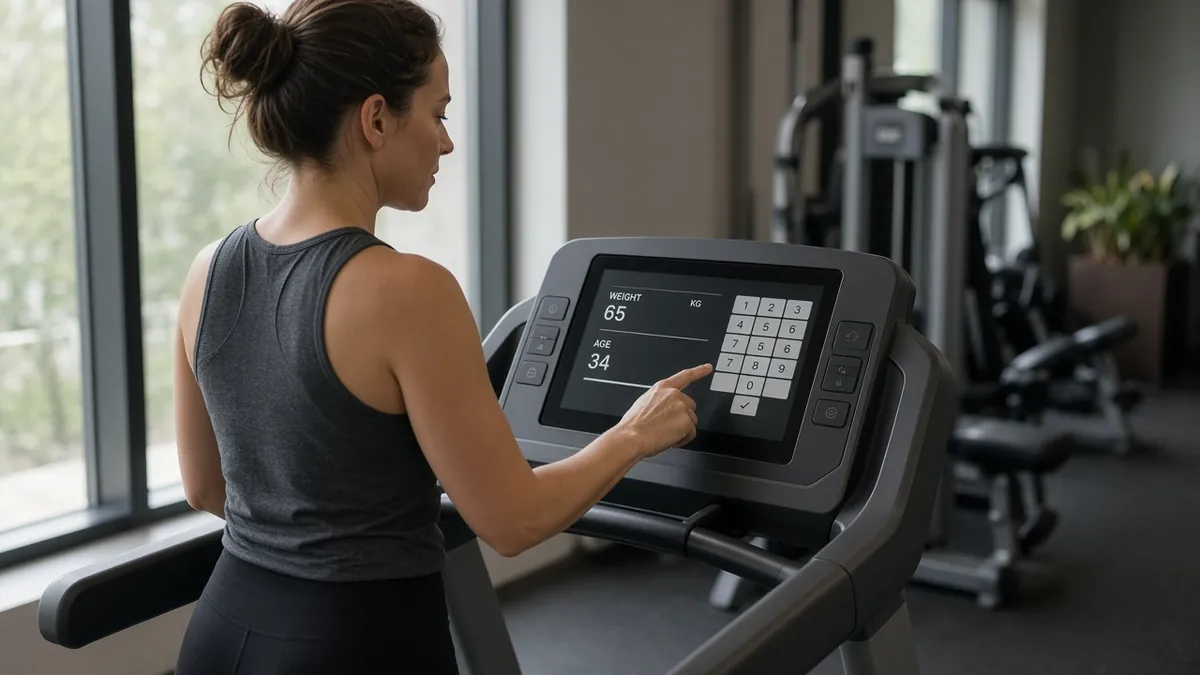
2. Skipping the Weight Entry (or Entering an Old One)
Calorie burn for a given speed and grade scales directly with body weight. If you skip the weight prompt, the console uses a preset reference value. Here is what that does to a 30-minute walk at 3.5 mph and 5% incline if the console assumes 155 lb:
| Your real weight | Real estimate (ACSM) | Console at 155 lb | Error |
|---|---|---|---|
| 120 lb (54 kg) | 166 kcal | 214 kcal | +29% too high |
| 200 lb (91 kg) | 277 kcal | 214 kcal | 23% too low |
| 250 lb (113 kg) | 346 kcal | 214 kcal | 38% too low |
Lighter people get flattering numbers; heavier people get short-changed. The same problem appears if you lose 20 lb and never update the setting.
Fix: enter your current weight every session, or ignore the console figure and use a calculator that takes your weight.
3. Reading Gross Calories as Net
Almost every display shows gross calories, including the roughly 1 MET your body burns at rest. For a 154 lb person, a 30-minute flat walk at 3.5 mph is about 129 gross calories but only 94 net. On an easy walk, more than a quarter of the “burn” would have happened on the sofa.
Fix: for weight-loss planning, use net calories. The treadmill calorie deficit calculator helps you plan the weekly picture.
4. Treating Any Device as Exact
Consoles use formulas built around an average person. Wrist trackers estimate from heart rate and movement. Neither measures oxygen. A Stanford study of seven wrist-worn devices found none estimated energy expenditure with an error below 20%, and walking produced the highest errors. Our comparison of treadmill vs Apple Watch, Fitbit and Garmin explains why the numbers never agree, and why treadmills overestimate calories covers the console side.
Fix: pick one method and stick with it, so session-to-session comparisons are fair. Treat the absolute number as an estimate with a margin.
5. Eating Back the Full Number
Even a perfect calorie estimate can be undone by food. In the E-MECHANIC randomized trial, adults doing 24 weeks of supervised exercise lost less weight than their calorie burn predicted, by 1.5 to 2.7 kg on average, because their daily intake rose by roughly 90 to 125 calories. Add a habit of deliberately eating back the console figure, which may already be high, and a planned deficit can vanish.
Fix: do not treat exercise calories as a food voucher. Our guide on whether to eat back treadmill calories gives a step-by-step method based on your weigh-in trend.
6. Ignoring Incline, or Overdoing It
Incline is the cheapest way to add effort without speed. For a 154 lb person at 3.5 mph, raising the grade from 0% to 4% lifts a 30-minute walk from about 129 to 196 calories, more than 50% extra. Many people never touch the button.
The opposite error is going too steep too soon. At 12–15%, people often grab the rails (see mistake 1), shorten into a shuffle, or end up with sore calves. A steep grade you cannot hold hands-free is worth less than a moderate one you can.
Fix: add incline in 1–2% steps and only progress when you can walk tall without holding on. The treadmill incline calorie calculator shows what each step is worth for your weight.
7. Chasing Big Single-Session Numbers
Social media is full of “burn 1,000 calories in an hour” workouts. For most people walking, 1,000 calories takes two to four hours; even running at 6 mph takes a 150 lb person about 1 hour 26 minutes. Intervals do not rescue the math: the afterburn effect after high-intensity intervals averaged only about 32 calories in short measurement windows in a 2021 systematic review. Chasing unrealistic targets leads to frustration, overuse injuries or, worse, eating to a number that never happened.
Fix: judge progress by weekly totals and your weight trend over three to four weeks. See how long it really takes to burn 1,000 calories and HIIT vs steady-state treadmill cardio for honest numbers.

How Much Do These Treadmill Mistakes Add Up To?
They stack, and they mostly point the same way. Take an illustrative 140 lb walker who skips the weight entry on a console that assumes 155 lb, leans on the rails at a steep grade, and reads the gross figure. The default weight alone inflates the reading by about 11%. Leaning back can remove up to about a third of the real work at 10% incline.
Resting calories make up roughly 12–27% of the gross total depending on intensity (about 27% of a brisk flat walk, 12% of a steep 12-3-30 session). None of these show up on the display, so the walker could be looking at a number close to double the extra calories the session really added.
Walkers are hit harder than runners because resting energy is a bigger share of a low-intensity session, and because steep walking is where people hold the rails. Runners are more exposed to tracker errors and to the habit of eating back big numbers after long runs.
Smaller Treadmill Mistakes That Add Up
- Double-logging. A watch sync plus a manual entry counts one workout twice in many apps.
- Counting paused time. Some displays keep a running clock while the belt is stopped. Use moving time.
- Letting the pace drift. If you set 3.5 mph and keep nudging it down when distracted, the burn drops with it. At 5% incline, 45 minutes at 3.2 mph is about 23 calories less than at 3.5 mph for a 154 lb walker. Small, but it adds up over weeks.
- An uncalibrated machine. Belt speed and incline sensors drift with wear. If a home treadmill feels off, check the manual’s calibration routine.
A Checklist to Avoid Treadmill Mistakes Every Session
- Enter your current weight (or plan to ignore the console number).
- Clip on the safety key.
- Decide speed and incline in advance and write them down.
- Walk or run hands-free; lower the incline if you need to hold on.
- Log net calories from one consistent method, once.
Fixing these treadmill mistakes usually does more for the number you log than buying a new watch.
Most of these treadmill mistakes stack in the same direction, which is why the number on the display can look twice as useful as it is.
Related accuracy guides and tools
Frequently Asked Questions
Does holding the treadmill handrails reduce calories burned?
Yes, especially if you lean back. At a 10% incline, leaning back on the rails cut energy cost by 31.8% in a peer-reviewed study. Holding on lightly while staying upright made a much smaller difference.
Why does my treadmill show more calories than my watch?
They use different formulas and inputs. Consoles may use a default weight and show gross calories; watches estimate from heart rate and motion. Neither is exact.
Should I enter my weight on the treadmill?
Yes. Calorie burn scales with body weight, so a default value can be off by 20–40% for people well above or below it.
Do treadmills overestimate calories?
Many readings run high because they show gross calories, cannot detect handrail use and may use a default weight. Use the number to compare your own sessions rather than as an exact figure.
What are the most common treadmill mistakes?
Holding the handrails is the most visible one. Eating back inflated calorie figures is probably the costliest for weight loss.
Bottom Line
Most treadmill mistakes that distort calorie numbers come from setup and habits, not the machine. Enter your weight, keep your hands off the rails, plan with net calories and judge progress by weekly trends. For numbers based on your own weight, speed and grade, use the incline calculator and read how we calculate them on our methodology page.